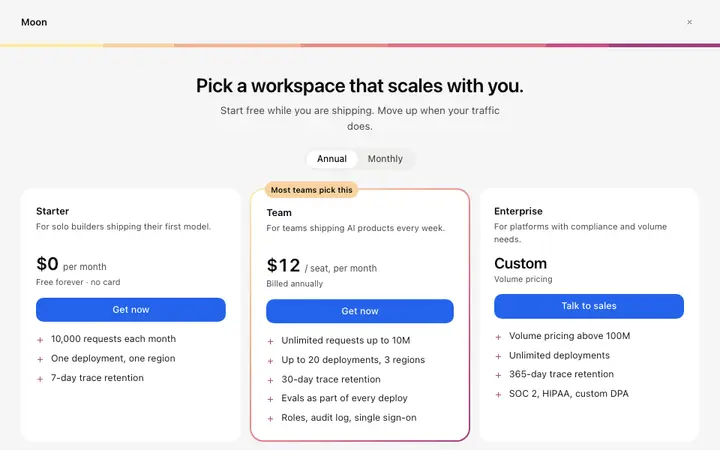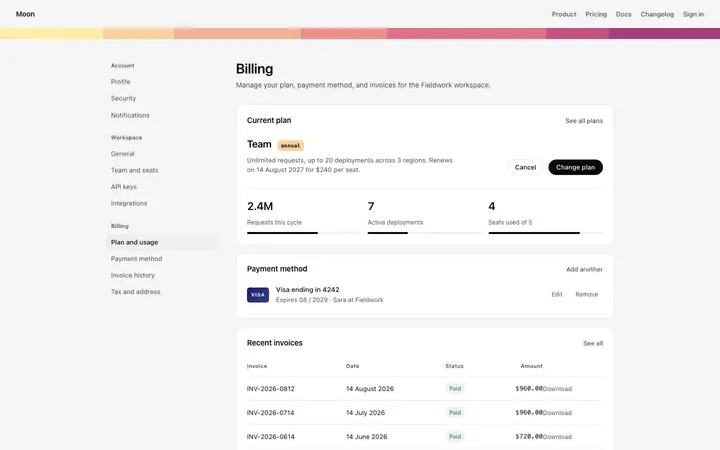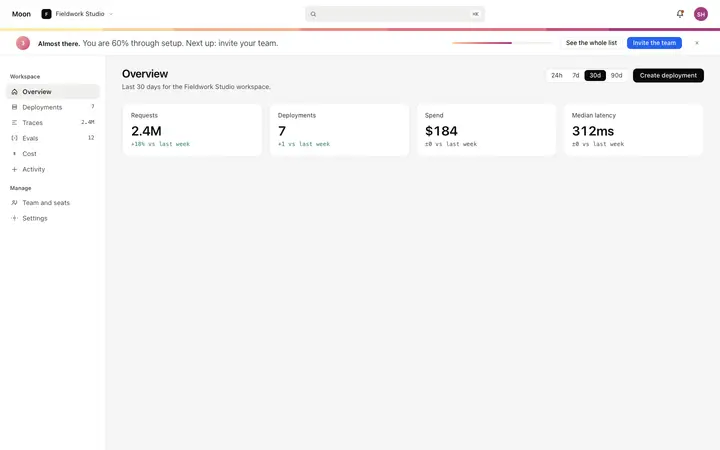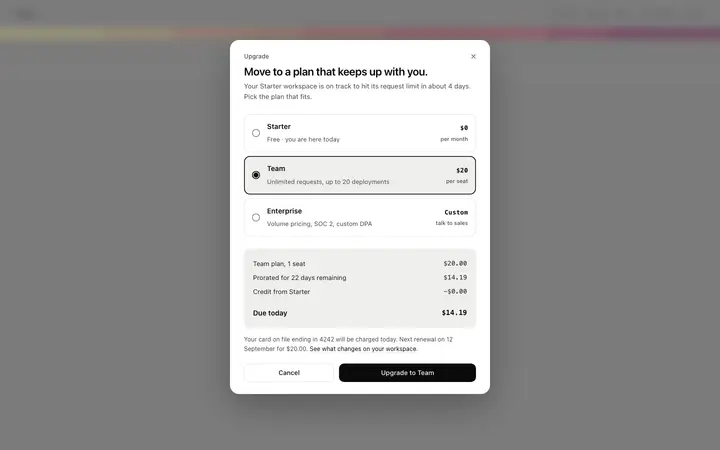
Upgrade plan modal template for SaaS apps
SaaS
Build this design with AI →People start your free trial, then let it run out without paying. The product is rarely the main reason. Usually trial users never reach the moment the product proves its worth, or the wrong people signed up in the first place. Here is how to find your cause and turn more trials into customers.
Trial numbers are easy to misread. Check these four things before you change the product or the price.
Benchmarks vary widely by trial type. A trial that asks for a card up front converts very differently from one that does not. Compare only with the same model.
Compare users who reached the product's first win with those who did not. If the first group converts well, the problem is getting people there, not the price.
Check conversion by traffic source and company type. A flood of low-intent sign ups drags the number down without anything being broken.
Look at what happens on the last day: did users see the upgrade, start checkout, and stop? A drop at checkout is a different problem from no interest.
Match what happens during your trial to the most likely cause, then jump to the fix.
| What you see | Likely cause |
|---|---|
| Most trial users barely use the product | They never reached the first win |
| Active users still do not pay | Price not justified, or paid adds too little |
| Lots of sign ups, very few buyers | Wrong audience or low-intent traffic |
| Users forget the trial ended | No reminders or follow-up |
| Users start checkout, then stop | Upgrade friction or surprise costs |
Each cause comes with the sign to look for, the fix, and where to see it done well.
They sign up, look around and leave before the product does anything useful for them.
Fix: shorten the path from sign up to the first real result, and measure how many trial users get there. Onboarding drop off →
A trial sign up shows interest, not intent to buy. People outside your audience will not pay, however good the trial is.
Fix: make the landing page say clearly who the product is for, and judge trials by source.
Too long and there is no urgency; too short and users never get to value.
Fix: set the length by how long it takes a typical user to reach the first win, plus a little time to build the habit.
Users cannot see the part of the product they would actually pay for.
Fix: let trial users try the features that make people pay, even with limits.
Users forget, the trial expires quietly, and the moment is gone.
Fix: send a reminder before the end, with what they have built and what they will lose.
Users like the product but cannot see what paying adds over the trial or a free plan.
Fix: show what paid unlocks in their own words, next to the result they already got. Pricing page not converting →
The upgrade button is buried in settings, so ready buyers give up.
Fix: show a clear upgrade prompt at the moments users hit a limit or get value.
Long forms, surprise taxes or a confusing plan choice at the last step.
Fix: a short checkout with the price, plan and what happens next stated up front.
The person on the trial is not the one who pays, and nobody else on the team saw it.
Fix: make inviting teammates part of the trial, so the product has more than one supporter.
Split trial users by what they did, not just whether they paid.
Shorten onboarding and remove setup before value.
Show what paying adds, at the moment users see value.
Prompts at limits, reminders before the end, and an easy checkout.
Length, card up front or not, and which features to unlock.
Ask Mon, the AI design assistant, describe your trial, your onboarding and where users stop, and Mon tells you what to change first.
SaaS
Build this design with AI →SaaS
Build this design with AI →SaaS
Build this design with AI →SaaS
Build this design with AI →SaaS
Build this design with AI →Dashboard
Build this design with AI →Every template above is an original BrowserMoon design. Preview them all; copy the code with a BrowserMoon licence.
Get a licenceMost often they never reached the moment the product proved its worth. Other common causes are the wrong audience signing up, no reminder before the trial ends, and not seeing what paying adds.
It depends heavily on the trial type. Trials that ask for a card up front and trials that do not convert very differently, so compare only with trials like yours.
Long enough for a typical user to reach the first real result and start building a habit, and no longer. Common lengths are 7, 14 and 30 days; pick the one that matches how fast your product shows value.
Asking for a card means fewer sign ups but more serious ones. Not asking means more sign ups that need more help to convert. Pick the model that fits how quickly your product shows value.
Yes. Describe your trial and where users stop to Mon, the AI design assistant, and it tells you which step to fix first.
Related: Onboarding drop off · Pricing page not converting · Landing page not converting · Paywall design